Owana
Friendship app · Our own product · 2026
Owana is Berraco’s own product: a native app that helps women in Spain and Latin America make real friends. No catalog of faces, no swiping: every day it introduces you to three women at most who you really click with, and a friendship only opens up when both of you propose it. We took it from idea to an app that compiles on Android—and, on October 20, 2026, through a full pivot in design. It hasn’t launched yet.

- Client
- Owana · our own product
- Year
- 2026
- Our role
- Product, design, and development, from architecture to design system
- Platform
- Native iOS + Android app
- Status
- In design · not launched yet
- 24
- questions in the compatibility quiz, across 6 dimensions
- 3
- introductions a day, max
- 0
- swipes, percentages, or visible rejections
Context
01
Making friends as an adult is hard.
Owana started out as a network of support circles for women. With the app already built, we decided its main mission was something else: building one-on-one bonds with a deep connection. The circles stay, but in the background.
Before designing it, we looked at the market: swiping for friends has flopped even at the category leader, and what works is a handful of well-chosen introductions with the “why” right there in plain sight.
The challenge
02
Don’t make it feel like a dating app.
An app for meeting people runs into two habits: swiping, which turns people into a catalog, and rejection, which stings even when nobody says it out loud. On top of that, it handles data that GDPR gives special protection.
- 01No swiping, no “likes,” no way to pass on a person.
- 02Nobody should ever be able to tell they weren’t picked.
- 03Explain why two women click, without scoring anyone.
- 04Friendship around the corner or across an ocean, in Spanish for the whole Spanish-speaking world.
- 05Private by default, with sensitive data kept out of every recommendation.
How we worked
03
The process, step by step
- 01
Architecture · July 2026
Before the first line of code, research with adversarial verification locked in the decisions that are expensive to reverse: React Native with Expo, Supabase with chat on Broadcast, and selfie verification that’s manual and ephemeral.
- 02
Build · July and August
Four phases—foundation, core, retention, and revenue—plus one-on-one introductions, with the “no rejection” principle written into the code as a rule.
- 03
Native · October 10
The first Android release build, tested end to end on an emulator: 23 flows, from sign-up to deleting your account.
- 04
Redesign and name · October 10
A new look with atmospheric photography, glass, and Inter, plus a brand name: Owana. “Tribu” stays on as the codebase’s internal name.
- 05
Master Document v2 · October 11
The product document, researched, critiqued three times, and applied: 25 decisions, 52 commits, and 45 migrations, with a QA pass whose 27 findings were all fixed in a single round.
- 06
Friends first · October 20
A pivot in Pencil: the app opens on Friends, the compatibility quiz and live photo come in, and everything about urgent help goes out. Design system v4 and 18 new screens, still to be built in code.
Problems & fixes
04
Problems we ran into and how we fixed them
Chemistry without percentages
- Problem
- A compatibility percentage reeks of dating apps and turns a person into a grade.
- Fix
- Every strong match is a named “point of harmony,” broken down by dimension, and the app also shows where the two of them differ. Only profiles with high, very high, or exceptional compatibility get introduced—spelled out in words.
- Result
- A percentage never shows up.
No rejection, not even by silence
- Problem
- If you propose a friendship and the other person doesn’t answer, any notification is a rejection.
- Fix
- No swiping and no pass button. A friendship only opens if both of them propose it; if not, the proposal quietly expires after 7 days and nobody finds out.
- Result
- There’s no screen anywhere that says “you weren’t picked.”
A photo that isn’t a storefront
- Problem
- The profile photo is the hook in dating apps, but without a face there’s no trust.
- Fix
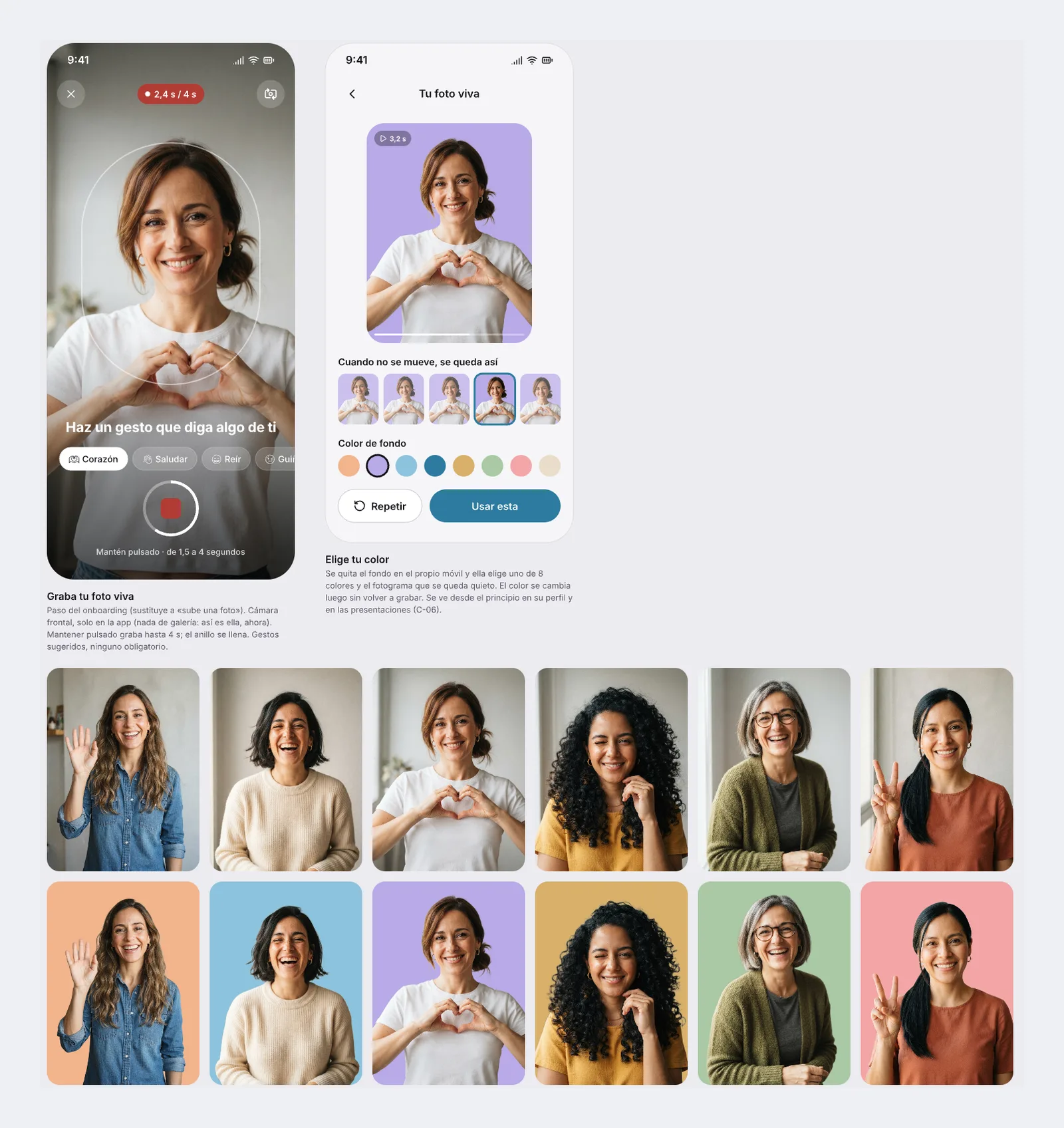
- The live photo: a 1.5- to 4-second gesture shot with the front camera, no sound and no camera roll, with the background cut out and one of 8 colors behind it. It plays once and then holds still; with “reduce motion” on, it never moves.
- Result
- Designed in Pencil, not yet in code.
Sensitive data, locked down before the first user
- Problem
- Before there was a single user, any verified account could read other women’s life experiences through the API, and the members of grief and health circles were visible: GDPR Article 9 data.
- Fix
- Every experience gets its own visibility level, private by default; members of sensitive circles are private, and the moderation AI gets no health data.
- Result
- Fixed, and covered by 2,252 passing database tests.
A selfie that doesn’t judge
- Problem
- Selfie verification is biometrics, and a women-only app that verified gender with AI has already ended up in court.
- Fix
- Manual review during the beta, no gender classification, and the selfie kept in separate storage that’s wiped once the decision is made. It’s never reused as a profile photo.
- Result
- Not a single real selfie until the impact assessment is done.
Android edge to edge
- Problem
- On Android 16 the window no longer resizes for the keyboard: it covered the chat box and the report sheet.
- Fix
- react-native-keyboard-controller with automatic offset, and in sheets, the keyboard height added by hand.
- Result
- All 23 native QA flows, without a single crash.
What we built
05
Pieces of the project
 01
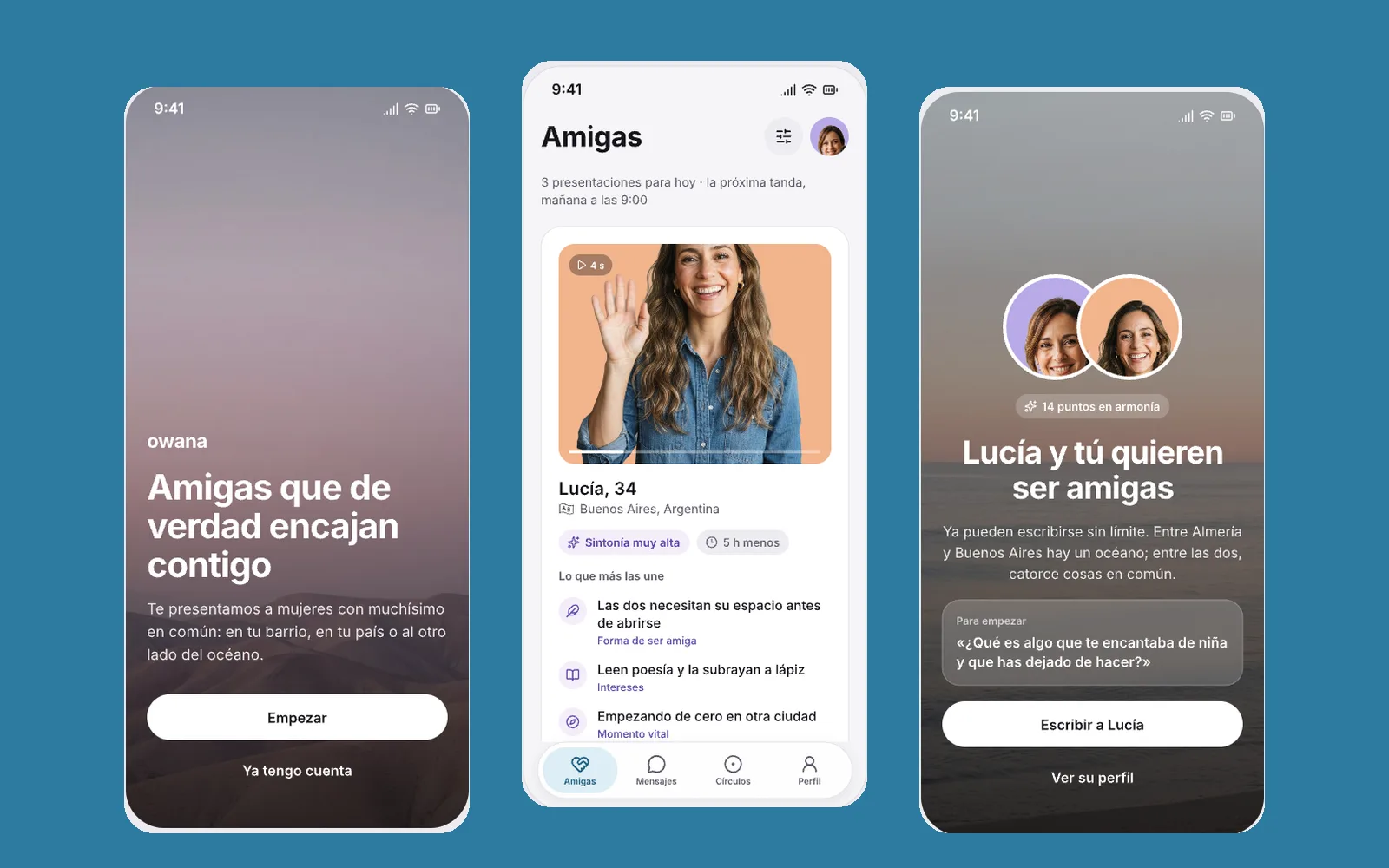
Friends
The app opens here: today’s introductions, three at most.
 02
The live photo
A gesture of up to 4 seconds, background cut out, in the color you pick.
 03
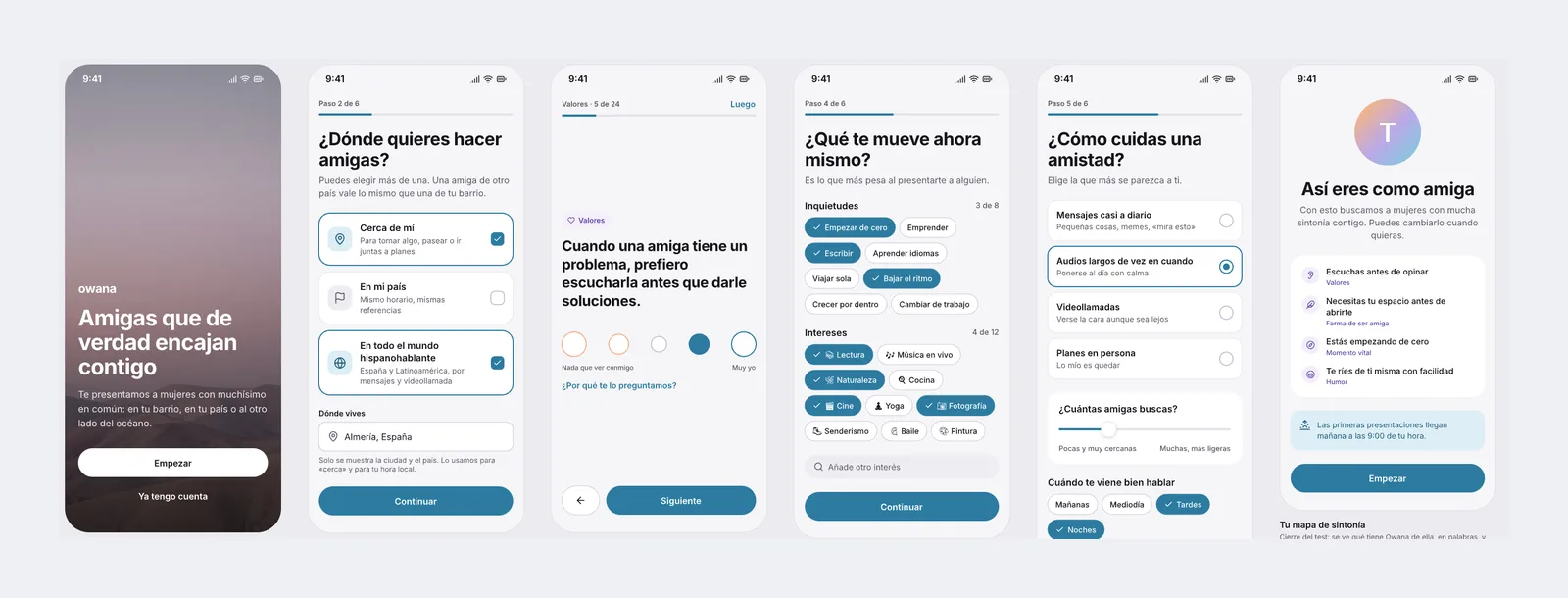
The compatibility quiz
24 questions across 6 dimensions: values, concerns, interests, humor, the kind of friend you are, and where you are in life.
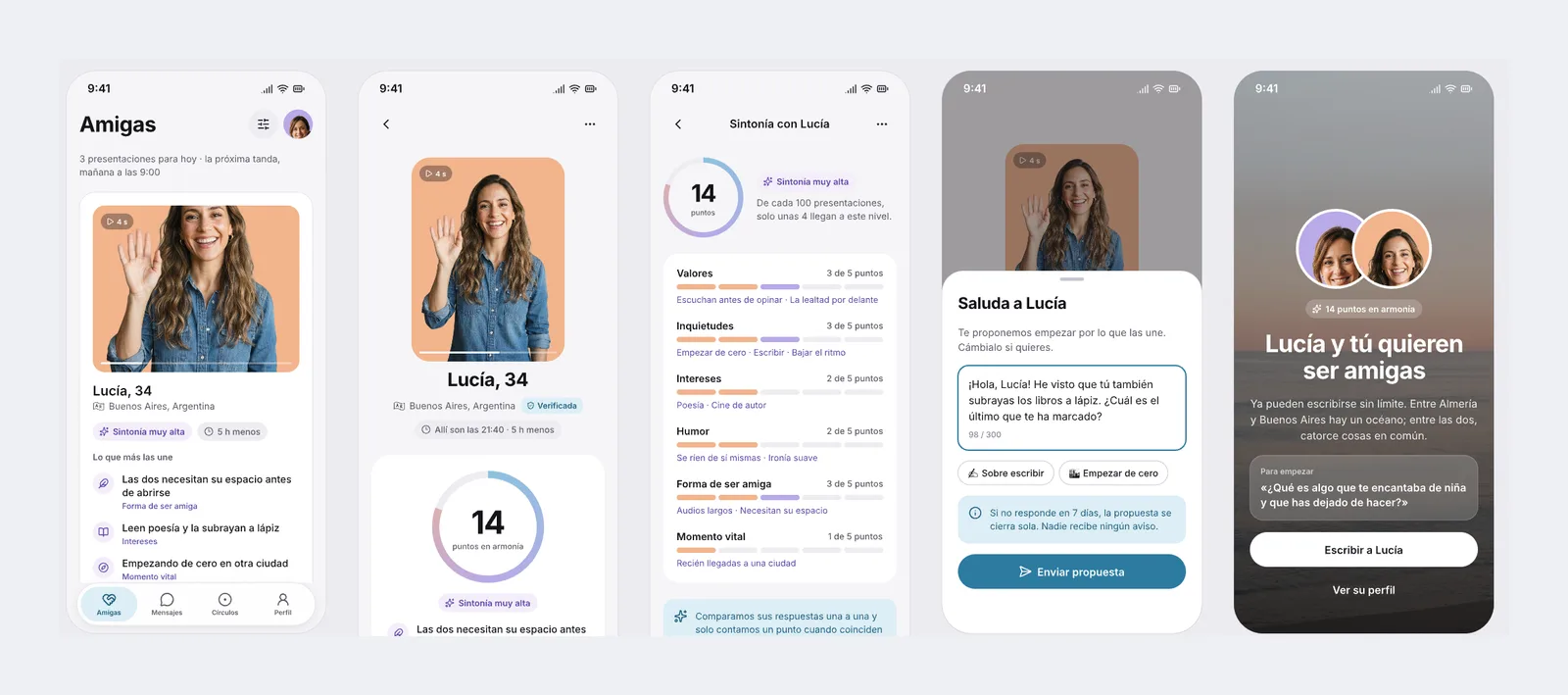 04
Introduction and mutual connection
Why they click, where they differ, and the moment they both say yes.
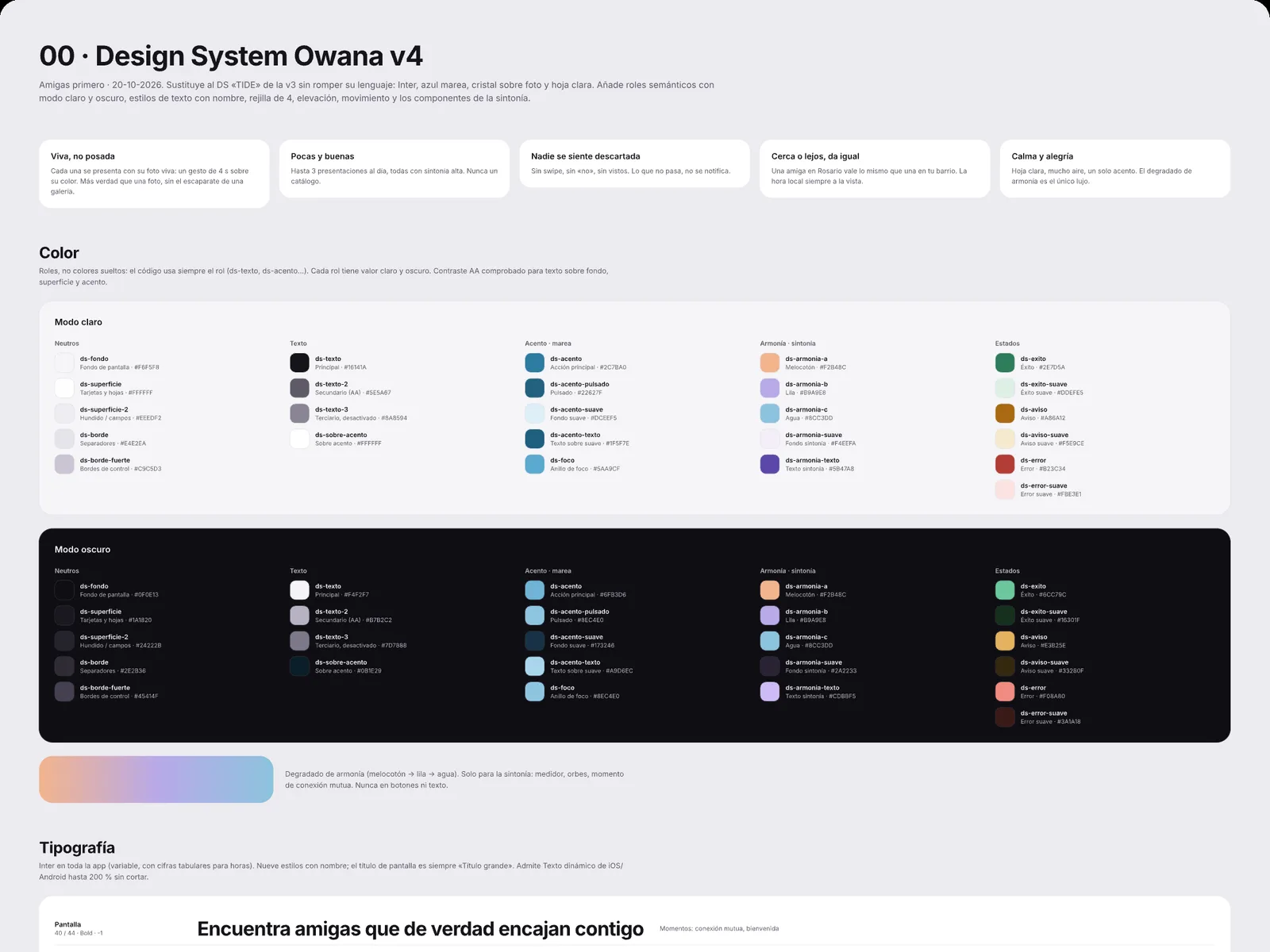 05
Design system v4
Role-based color with light and dark modes, type, a 4-pt grid, and components with every state.


Results
06
What we pulled off
18
v4 screens
Designed in Pencil on October 20, 2026, along with their design system.
23
native Android flows
Run on an emulator without a single crash.
2,252
database tests
Plus 1,199 app tests, all passing after Master Document v2.
25
product decisions
Researched, critiqued, and applied in a single round.
7 days
and a proposal quietly expires
Neither of them gets notified.
Services
Built with